
What Scotland can learn before Ask and Act begins
Scotland is at the point where homelessness prevention has to move from principle into practice.
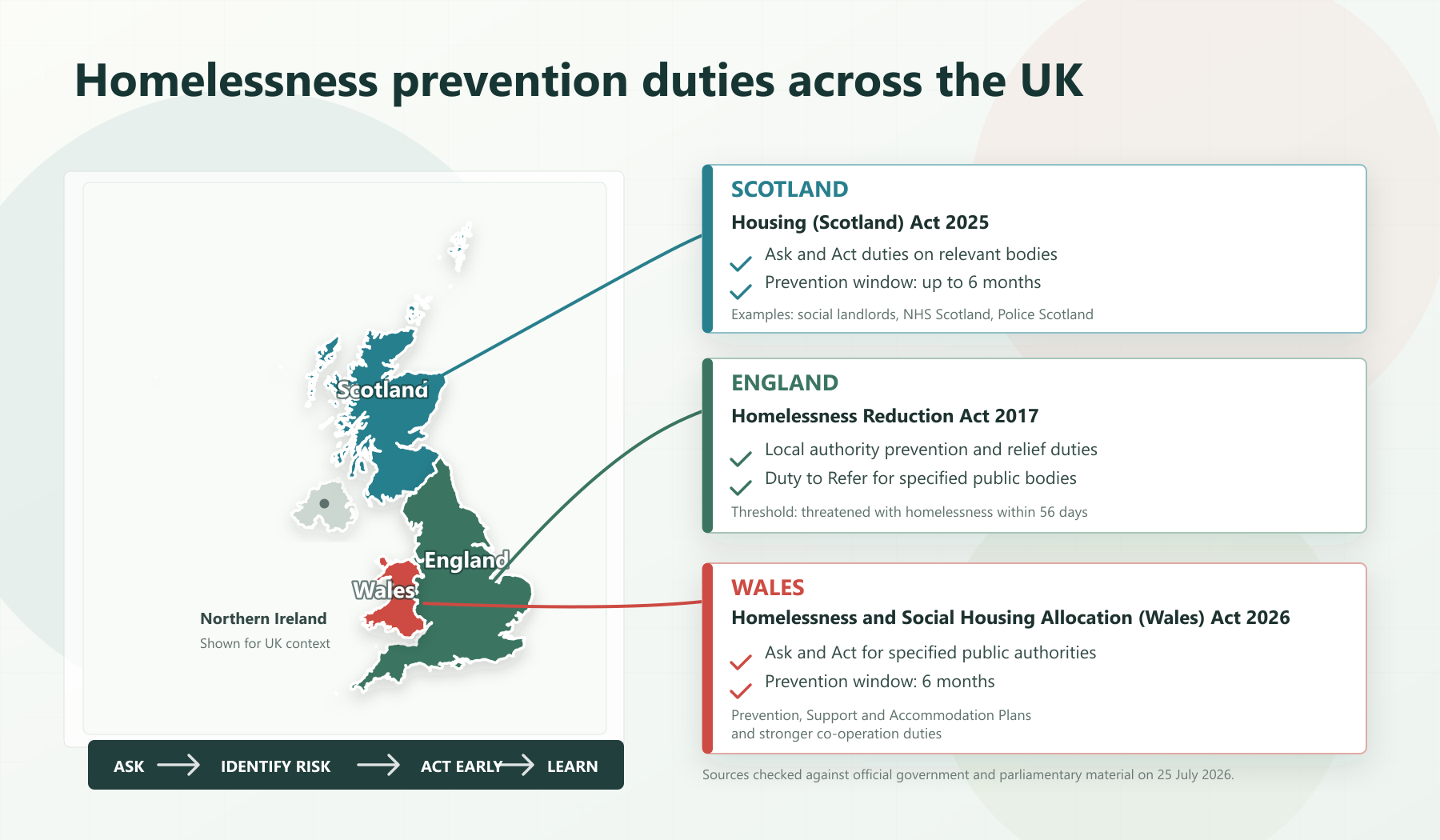
The Housing (Scotland) Act 2025 creates new Ask and Act duties for relevant bodies, including social landlords, NHS Scotland, Police Scotland, Local Authorities and others. It also extends local authority prevention activity to people threatened with homelessness within six months, rather than two.
I believe that is the right direction. But the lesson from the rest of the UK is that duties only work when people have the confidence, tools and housing options to act early.
Wales showed the value of acting sooner
Wales moved first. The Housing (Wales) Act 2014 shifted the system towards prevention, rather than waiting until people were already homeless.
The early figures are useful. In 2016-17, homelessness was successfully prevented for 62% of households assessed as threatened with homelessness. Relief worked less well. Where people were already homeless, 41% of cases were successfully relieved.
That is the point of prevention. It is usually easier to help someone keep their home, or move before crisis, than to resolve homelessness after it has happened.
But Wales also shows why Scotland should be careful with the data. Outcomes varied by area, and the figures did not always explain the type of cases, the resources available, or the local housing pressures.
That has not gone away. In 2024-25, Welsh Government statistics show prevention was successful in 57% of cases, while relief was successful in 25%. Earlier help still performs better, but the wider pressure on the system is clear.
Scotland should measure Ask and Act, but not turn early data into blunt league tables.
The useful questions are what risk was found, what action was possible, what happened next, and what did the system learn?
Wales is now going further through the Homelessness and Social Housing Allocation (Wales) Act 2026. That is worth noting. Wales has not moved away from prevention. It is trying to make it earlier, wider and more structured.
England showed the limits of referral
England’s Homelessness Reduction Act 2017 widened access to prevention and relief duties. The early evidence showed better results when people were helped before homelessness happened. In the first 12 months, 58% of prevention duty cases ended with accommodation secured, compared with 43% of relief duty cases.
But England’s Duty to Refer also gives Scotland a warning.
Referral can help. It can open a door that might otherwise stay closed. But referral is not the same as prevention.
The UK Government’s call for evidence found mixed views on the Duty to Refer. Only 44% of respondents felt it had helped prevent homelessness, while 37% felt it had not had an impact. Some referrals were incomplete, some came too late, and some were not made at all.
The bigger issue is what happened after referral. The evaluation found that public bodies did not have to keep working with housing teams once a referral had been made. Some local authorities felt responsibility was being passed to housing options staff, rather than shared around the person.
That is the bit Scotland needs to avoid.
If another service identifies risk and simply passes the person to housing, the burden moves to housing services. The person may also be left navigating another process, retelling their story, and waiting for help from a system they may already find difficult to trust.
Ask and Act has to be stronger than that.
Sometimes the right Act will be a referral. Sometimes it will be advice, reassurance, a practical step, a warm handover, or helping someone understand their options before the issue gets worse. The point is not to move the responsibility as quickly as possible. The point is to do something useful with what the person has told us.
Scotland now has its own practice evidence
Since I started drafting this, Homeless Network Scotland and SFHA have published the learning report from the Scottish Government’s Upstream Homelessness Prevention Fund.
That report matters because it is not abstract policy. It is practical learning from seven partnerships between Registered Social Landlords and third sector organisations, testing upstream prevention before Ask and Act becomes routine.
Across the pilots, 943 people accessed Upstream services. When asked about housing, 673 were identified as being at risk of homelessness. When partners acted on what people said, 662 were supported to prevent homelessness.
Those figures should still be treated carefully. They are useful learning, not final proof of long-term outcomes. But they show that earlier, relational and practical support can change what happens before crisis.
The report also says something important about the Act. Action is not always a large intervention. It is not always a referral or a formal support package. Sometimes an early conversation with the right advice is the intervention someone needs.
That is the space Ask:Enact has been working in.
The Aberdeen Task and Activation Partnership, or ATAP, is one of the projects covered in the Upstream report. It tested a multi-agency approach to prevention, combining earlier identification, rapid action and flexible financial support.
Ask:Enact received a modest amount of funding through ATAP to develop an MVP. That work helped test how staff could move from an early conversation to useful action, with prompts, pathways and better information sitting behind the conversation.
The impact was practical and ATAP helped show that Ask and Act is not only about identifying risk. It is about giving people a clearer route to advice, support and action before the situation becomes a homelessness crisis.
The hard edge is still housing supply
Prevention duties do not create homes.
The Upstream report is honest about that. Wales and England show the same thing. Earlier prevention helps, but it cannot remove the pressure caused by limited social housing, temporary accommodation, long waits and weak rapid rehousing options.
I don't think that weakens the case for Ask and Act. It makes implementation more important.
The earlier we act, the more options people may still have. By the time someone reaches crisis, the system has often narrowed to temporary accommodation, emergency advice and waiting lists.
What Scotland should take from this
I think there are five lessons.
First, prevention has to happen earlier than crisis.
Second, asking only helps if staff know what they can do next.
Third, referral is not enough. Warm handovers, feedback and shared accountability are important.
Fourth, the Act can be small and still meaningful. The right advice, at the right moment, can change the path someone is on.
Fifth, data should help the system learn. Counting questions asked will not be enough.
Scotland has good legislation. It now has practical pilot learning. The next job is building the ordinary working conditions that make prevention possible: confident staff, clear routes for action, cash-first flexibility, better data sharing, local partnerships and enough housing options to make early action real.
Prevention will not happen because the law says it should.
It will happen when people can ask early, understand the risk, and do something useful before crisis.
The full Learning Report from the Scottish Government ‘Upstream’ Homelessness Prevention Fund 2025-26 can be read here UHPF Learning Report