
Ask:Enact version 3: Manage teams, Improve context
Released to users on 30 July 2026
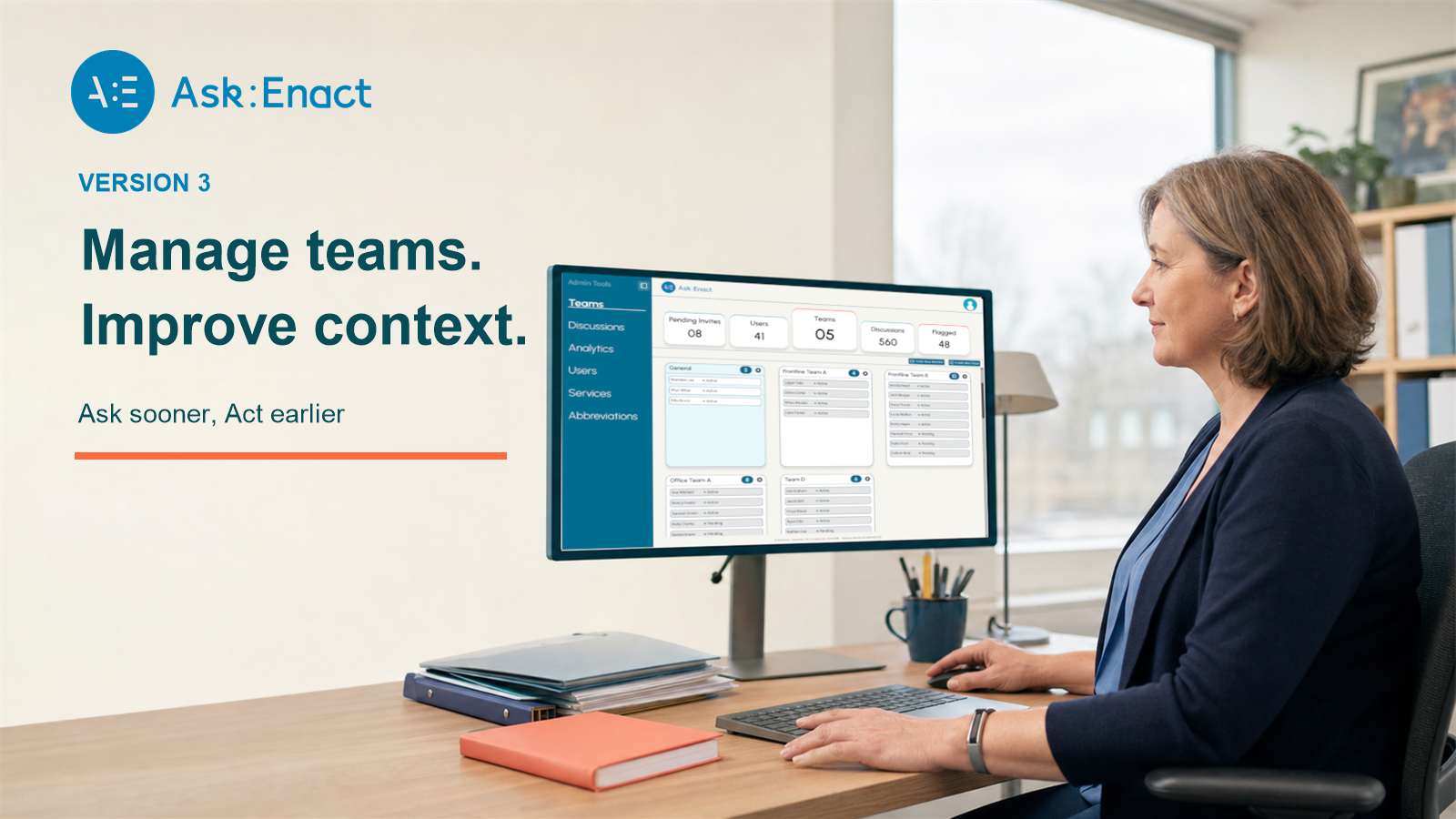
Version 3 is live
On 30 July, we made version 3 of Ask:Enact live to users.
This release moves Ask:Enact beyond a standalone tool. It gives the system more context about the professional using it, the team they work in and the routes available when a concern needs to be escalated.
The aim is to enable a professional to have a better conversation, get to useful information more quickly and help the person in front of them take an appropriate next step sooner.
Ask:Enact still supports professional judgement. It does not make automated decisions about people. Version 3 gives that judgement better information and a clearer organisational context.
Better answers start with better context
Housing risk rarely appears as a neat question. It can sit underneath worries about money, health, safety, family relationships or somewhere to stay. The useful response will also depend on who is asking, what their role is, where they work and what help is available locally.
Version 3 introduces a new administration area where organisations can create and manage teams, invite users and set appropriate team and organisation permissions. Team administrators can add a description of the team, define its role and record the escalation routes it uses.
That information helps Ask:Enact respond in a way that better fits the professional and their working environment. A health professional, police officer, community worker and housing specialist may be dealing with the same underlying risk, but they will not need the same level of detail or the same route for action.
We have also introduced a new AI workflow designed to give richer and more useful responses. Users can adjust how responses are presented through their profile settings, while team-level settings give the system consistent information about local practice and escalation.
Service matching has been improved too. Finding a service name is not enough if it is not relevant to the situation or does not provide a practical route forward. This work will continue, because service information changes and any matching system is only as useful as the information behind it.
Picking up where the conversation left off
Professionals can now search their previous Ask:Enact conversations, reopen them and ask further questions. Previous chats are no longer a read-only record.
That sounds like a small change, but it deals with a real frustration. Housing situations develop over time. New information becomes available. A professional may need to return to a conversation after checking something with a colleague or speaking to the person again.
Being able to continue the conversation means less repetition and a more useful record of how the situation has developed. Team administrators can also review team usage, giving them better oversight without removing responsibility from the professional handling the situation.
Built from what users told us
The June focus groups gave us a useful mix of reassurance and challenge.
Participants generally found Ask:Enact easy to navigate. They said the language was clear, the interface required few clicks and the action lists were easy to understand. In the scenarios tested, the guidance was broadly consistent with professional judgement.
The feedback was not completely tidy, which is exactly why we test. Some responses varied in length even when the question was similar. Some felt too generic for specialists. Users wanted more local service detail and an easier way to find and reuse earlier conversations.
Version 3 responds to those themes through better context, a new response workflow, improved service matching and searchable conversations. It does not resolve every user requirement, and the focus-group feedback is not proof of impact. It is practical evidence that helps us decide what to build and test next.
A foundation for Prevention Intelligence
There is something in this release for every kind of user. Frontline professionals get more useful responses and better access to previous work. Team administrators get tools for managing users, roles and local context. Supervisors get a clearer view of how their teams are using Ask:Enact.
Over time, anonymised patterns from those conversations can show more than system usage. They can help us see which issues are appearing, where professionals struggle to find a useful route, which services are being suggested and where gaps keep getting in the way. Used carefully, that adds another layer of lived-experience insight to formal service data.
Version 4 will develop this further through Prevention Intelligence. The aim is not to create another performance dashboard or monitor individual workers. It is to help organisations learn from early signals, frontline practice and service context so they can improve pathways before more people reach crisis.
Version 3 is an important step towards that. It makes Ask:Enact more useful in the conversation today, while building the foundations for better prevention learning tomorrow.
If you are involved in implementing Ask and Act or designing homelessness prevention pathways, you can find out more at askenact.com.