
Six months into Ask and Act: what we are learning
Six months into the Aberdeen Integrated Prevention Pathways pilot, we are starting to see what is actually happening on the ground.
Ask:Enact sits within the wider Aberdeen Integrated Prevention Pathways programme. AIPP is testing how prevention can be strengthened across public and third-sector services: how organisations work together, how people are connected to support earlier, and how evidence from frontline work can shape future pathways and system design.
Ask:Enact brings a practical layer to that work.
It is being developed to help frontline staff recognise housing risk, understand what proportionate action could look like in their role, connect people to relevant support, and generate learning from the conversations happening across the system.
The Ask and Act pilot gives us an important opportunity to test all of that in practice.
Some of what we are seeing is encouraging.
Some of it is messy.
That is the point.
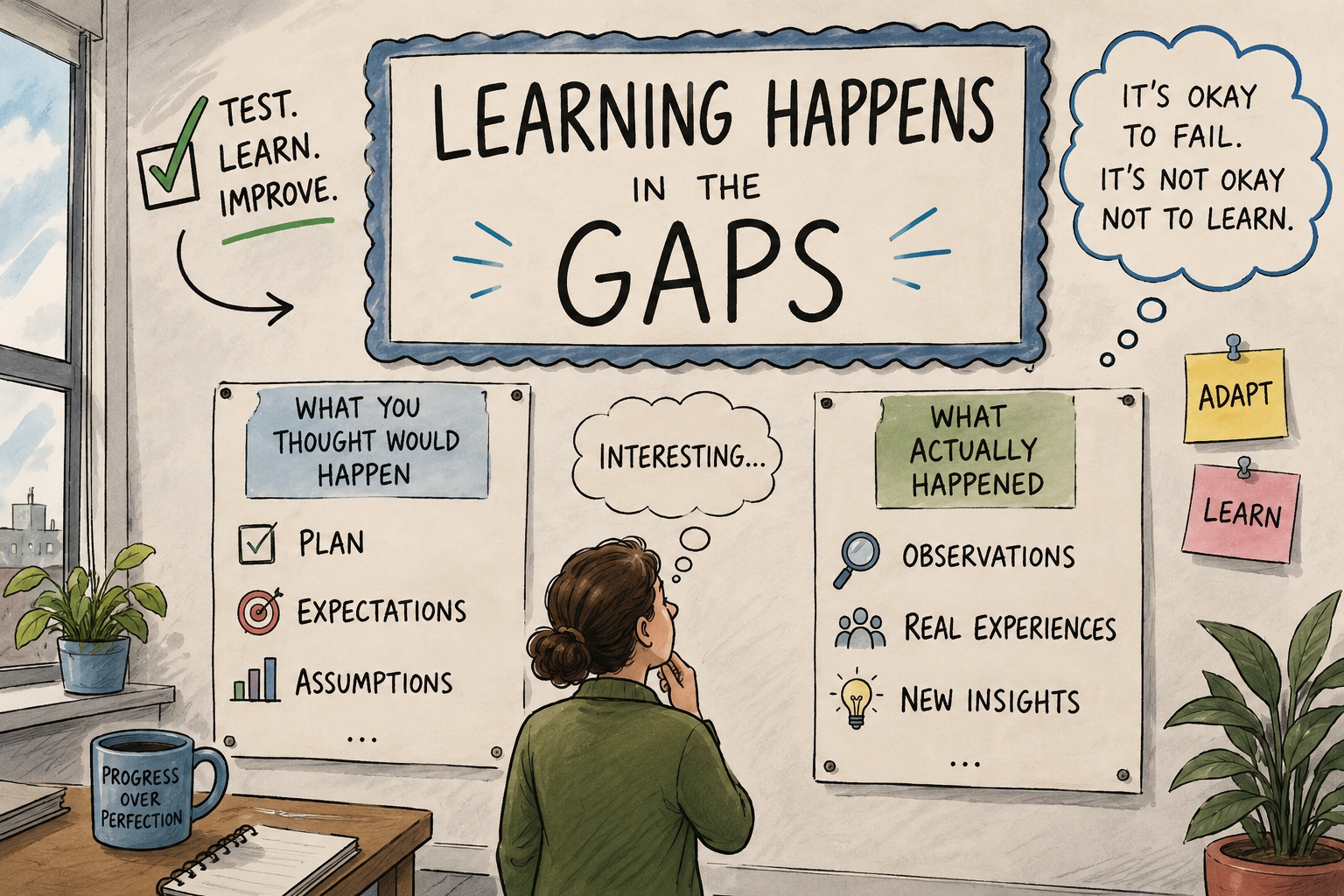
A pilot that only tells you everything is working probably is not testing hard enough. If you are working in an uncertain environment, you do not learn by pretending the plan was perfect. You learn by testing it, finding the gaps, listening to the people using it, and changing things before you scale.
That is how I am looking at the first six months.
Why we pilot
The Ask and Act duties sound fairly simple on paper. Relevant bodies should identify housing risk and act earlier, before someone reaches crisis.
The principle is difficult to argue with. The practical questions are harder.
How does a worker start a conversation about housing during a busy shift, particularly when the person in front of them has several other issues?
What happens if someone discloses a housing problem that the worker does not know how to resolve?
When is advice enough? When should someone be signposted to another service? When is a referral needed?
And how do we stop Ask and Act becoming another form that staff complete because they have been told to?
That is why we test.
Not to prove that the original plan was right, but to find the parts that will not work before they become embedded.
The problem was never simply asking
We built the awareness training on the assumption that some staff might not recognise the range of factors that can cause housing instability.
It quickly became clear that frontline staff from relevant bodies generally do recognise those risks. The main barrier is knowing what to do once a risk has been identified.
Staff need the confidence and knowledge to respond to what someone discloses. They also need a practical route to help that is accurate, accessible and does not simply add to their workload.
If that route leads to a waiting list or sends the person back to the same worker with the problem unresolved, staff will lose confidence in the process. That is where Ask and Act risks becoming a burden rather than a useful part of prevention.
That is the point where Ask and Act becomes an additional burden. The worker has spent time identifying the problem and trying to help, but the person is back where they started. If that happens repeatedly, staff will disengage with the process and the system will fail.
The design challenge is not simply teaching people how to ask about housing. It is giving them a reliable next step when they find a problem.
That response will not be the same for every profession.
A police officer, nurse, social worker and housing officer will approach housing risk differently. Their roles, knowledge and time with the person are different.
The support they receive needs to reflect that.
Existing routes are not far enough upstream
Existing intervention routes still have an important role. Police Scotland’s Interim Vulnerable Persons Database process (IVPD) or a referral to Adult Support and Protection (ASP) can prevent further harm when concerns have reached that level.
But are they the upstream prevention that Ask and Act was written to deliver?
Our interpretation is that they are not.
A former justice social work manager I worked with used to say, if the only available pathways for people in need are for criminals, then we risk criminalising everyone just to get them some help.
Ask and Act should help services respond to housing instability earlier, before the situation requires a formal protection or safeguarding route. Not every housing concern should become an iVPD or ASP referral.
The Aberdeen pilot is based on that assumption. We are testing what proportionate action looks like before someone reaches crisis, and how frontline staff can connect people to practical help without unnecessarily escalating the concern.
What the first six months show
So far, 80 people have taken part in briefing sessions. Manual end-of-shift data has been collected from Local Authority teams, Health Partners, Police and Social Work teams.
The early returns include:
- 144 end-of-shift records
- 674 frontline interactions
- 49 occasions when an Ask was considered appropriate
- 58 recorded Acts
These figures need care. They are learning data, not performance data, and should not be read as a simple funnel.
The returns were collected manually. Teams were at different stages of implementation and some recording was inconsistent. That limits what we can claim, but the data is still helping us understand how the duty might work in practice.
We have also run follow-up workshops with these teams. We wanted to understand what it was actually like to ask and act, what got in the way, how it differed from current practice and what staff would need from a system designed to support them.
The workshops give us context that the numbers can’t. They help explain why staff chose to ask, what action they took and where the available routes did not meet their needs.
First, Ask and Act does not apply to every interaction.
We should not tell staff to ask everyone a housing question regardless of the circumstances. That would quickly turn a useful duty into a tick-box exercise.
The better approach is to ask when there are indicators, concerns or a suitable opportunity. That requires professional judgement, which many frontline workers already use every day.
Second, most Acts are not formal referrals.
Advice, information, reassurance and signposting are all part of early prevention. Measuring prevention only through referral numbers would push more work into housing services, including cases where another response might be more appropriate.
The aim is to help staff take the right action at the right time, not to generate the highest possible number of referrals.
Third, confidence is connected to what happens next.
The workshops suggest that staff can recognise housing risk, but may be less likely to raise it if they do not trust the available response. They need to know that the information is accurate, the service is accessible and the next step has a reasonable chance of helping.
Confidence does not come only from training. It also comes from having somewhere useful to direct the person once a risk has been identified.
What we have changed
Ask:Enact is not being built as a static tool based on our original assumptions. Feedback from users is already changing it.
Staff need clearer guidance on proportionate action. They need better matching to local services and short outputs they can use during real work. Most importantly, they need routes that lead somewhere useful that doesn’t lead to a waiting list and the people getting fed up and disengaging.
A directory entry alone is not enough. Staff need to know whether a service is relevant, local and accessible. Sending someone towards a service that cannot help, has closed or has a waiting list simply moves the problem around.
We are also putting more emphasis on role-based support.
A generic answer will not be useful enough. A housing officer may need detailed information. A clinician may need a short prompt and a safe next step. A police officer may need something different again.
Ask:Enact needs to take account of the worker’s role, knowledge and local context.
Service information has to be trusted
The issue is not simply finding a service. Ask:Enact’s matching system depends on service information being properly curated and kept up to date.
Feedback suggests that professionals want to give people a clear action and a focal point for help. That focal point needs to be appropriate and accessible at the point of contact.
If someone is directed to a service that cannot help, they may return to the worker frustrated. They may also disengage and lose trust in the process altogether.
A useful match therefore needs to do more than produce a name or contact number. Staff need confidence that the suggested service is suitable, available and likely to respond.
Learning from elsewhere
England and Wales introduced homelessness prevention duties before Scotland. Their experience deserves a separate article, but there is one clear lesson for this work.
Legislation does not implement itself.
Earlier prevention can improve access and change practice. It can also become a hand-off. A form is sent, housing receives the problem and the original service moves on.
That is activity, but it isn’t necessarily prevention.
Practice still depends on staff confidence, suitable local services, partnership working and a shared understanding of what action means.
Scotland should avoid reducing Ask and Act to a short training session, a referral link and a reporting requirement. The duty has to work during the conversation between a worker and the person seeking help.
It also needs to work after that conversation. If the person is sent towards a service that cannot respond, the duty has not achieved much.
Letting the evidence change the plan
Projects can easily be shaped by the loudest voice in the room or by an original plan that nobody wants to challenge.
A useful pilot should push against that.
If staff say the system is too slow, we need to investigate it. If service matching isn’t local enough, we need to improve it. If the data shows that most Acts are not referrals, the product needs to reflect that.
If staff tell us they will be reluctant to ask unless they trust the available response, we need to build around that too.
Not every piece of feedback will be right, but each one should be taken seriously enough to test.
The same applies when delivery is slower than expected. Partners will not all move at the same pace, particularly where governance and professional risk are involved. Planning needs to reflect that rather than assuming a single timetable.
Test and learn is not a softer form of delivery. It is a more honest one.
Governance is part of implementation
Governance has been a major dependency during the pilot.
Third-sector involvement has been relatively straightforward. Statutory routes are progressing, but understandably take longer.
Local authority, NHS and Police Scotland routes are moving at different speeds. NHS engagement has begun through the Allied Health Partners, with wider work developing as governance processes are completed. Police Scotland engaged early, received access to Ask:Enact, and continue to consider how the Ask and Act duties fit within their structures.
The pilot needs to remain flexible enough to work with those different timetables.
Data governance, information assurance, professional risk and internal approval processes are not side issues. They directly affect what can be delivered and when.
Prevention does not create housing supply
There is another limit we need to state plainly.
Prevention duties do not create houses or remove waiting lists.
Ask and Act should help identify risk earlier. It should lead to better advice, signposting and referrals, while giving us better information about unmet need.
It won’t solve housing supply on its own.
A good prevention system may stop some situations from getting worse. It can also show where staff are repeatedly unable to find a suitable service or housing route.
That is not necessarily a failure by the worker or the tool. It may be evidence of pressure elsewhere in the system.
We need to capture and use that evidence. If Ask:Enact repeatedly shows that staff are trying to help but cannot find an accessible route, leaders need to see it.
What the next steps need to test
The next phase needs to move from early learning into proper system-supported testing.
We need to find out:
- whether staff can use Ask:Enact during real work without creating another burden
- whether they feel more confident raising housing risk when they have a clear response
- whether the information provided is accurate, local and accessible
- whether the suggested action is proportionate to the worker’s role
- whether people can reach help without being passed between services
- whether the system reduces unnecessary referrals
- whether it produces useful information about unmet need and service gaps
- whether it works across different teams and settings
- whether we can see what happened after staff identified housing risk
That final point is still a gap.
Staff need to know what happened after they acted. Services need to understand whether advice, signposting and referrals were useful. Leaders need to see where the system is blocking prevention.
Otherwise, we risk building another system that records activity without telling us whether anything changed.
Making the duty workable
After six months, I don’t think the main question is whether the principle of Ask and Act is right.
It is.
The question is whether we can make it work in practice.
We know many frontline workers already have the skills to recognise housing risk. We also know that confidence, knowledge and workload affect whether they feel able to raise it.
Staff need more than permission to ask. They need a response they can trust.
That means accurate local information, proportionate guidance and accessible routes to help. It also means being honest when suitable help does not exist or cannot be reached quickly.
The next six months need to test those parts properly and let the findings change what we build.
Ask and Act cannot become another policy that looks clear on paper and falls apart during frontline delivery.
It has to work in the conversation and lead to something useful afterwards.